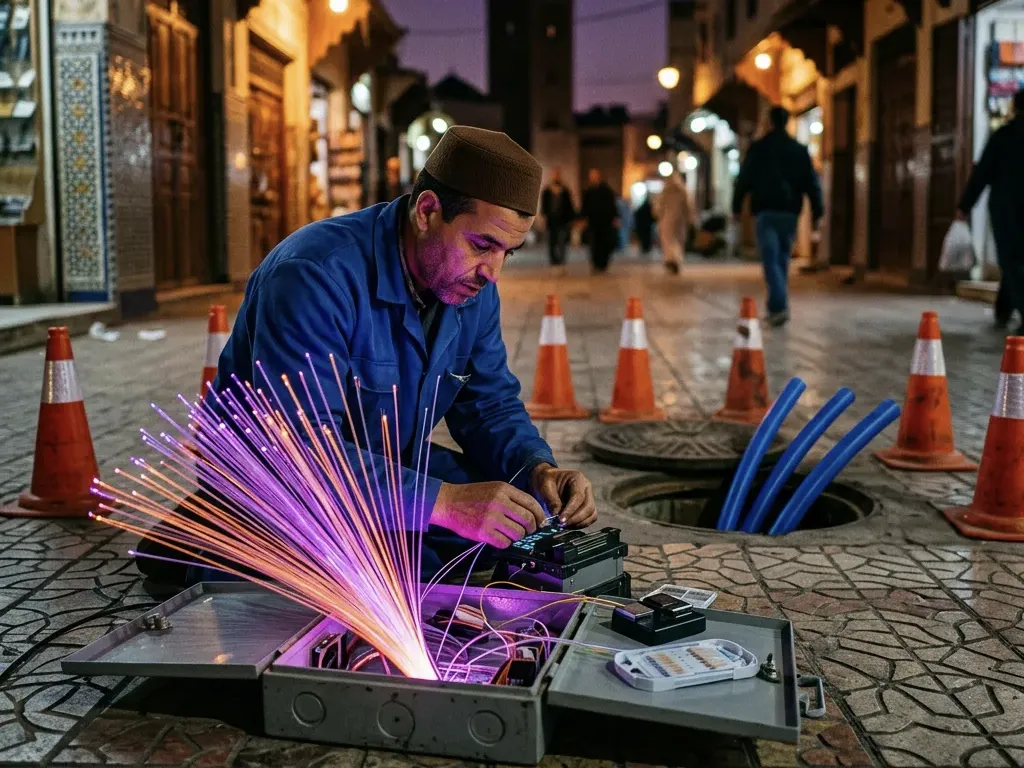
Since 2020, Morocco has experienced an unprecedented acceleration in fiber optic deployment. Driven by the three national operators — Maroc Telecom, Inwi, and Orange — the FTTH (Fiber To The Home) program is profoundly transforming connectivity across Moroccan cities. Behind every kilometer of fiber laid, specialized teams like those at INGTELMA work to build Morocco's digital infrastructure for tomorrow. Here's how this deployment works and what it concretely changes for cities and their residents.
1. What Is FTTH and Why Is It Revolutionary?
FTTH stands for Fiber To The Home — fiber optics delivered directly to the premises. Unlike previous technologies (ADSL, coaxial cable, fiber to the neighborhood node), FTTH brings fiber optics directly into the home or business premises, with no copper portion in the network.
- Very high symmetrical speeds: from 100 Mbps to 1 Gbps for both download AND upload — copper ADSL maxes out at 20 Mbps download and a few Mbps upload.
- Ultra-low latency: less than 5 ms on fiber versus 20 to 50 ms on ADSL — critical for video conferencing, cloud computing, and real-time applications.
- Connection stability: fiber is not sensitive to electromagnetic interference, distance, or weather conditions — unlike copper.
- Reduced shared bandwidth: each FTTH subscriber has a dedicated fiber from the home to the distribution hub, limiting congestion during peak hours.
- Future-proof infrastructure: fiber optic installed today will support bandwidth needs for the next 30 to 50 years without replacing the physical infrastructure.
2. FTTH Network Architecture: From the Exchange to the Home
An FTTH network isn't simply a fiber cable connected to an internet box. It's a complex architecture organized in multiple tiers, requiring rigorous design and precise execution.
Transport Network (Backbone)
- G652D single-mode fibers: high-capacity cables connecting telecom exchanges to neighborhood distribution nodes. Tens to hundreds of fibers per cable.
- L4T pull chambers: buried concrete manholes allowing cable routing and splicing between network segments.
- Optical nodes (OLT sites): technical rooms housing active OLT (Optical Line Terminal) equipment that manage connections for thousands of subscribers.
Distribution Network
- 24 to 96-fiber distribution cables: connect the OLT site to street cabinets (optical sub-distribution frames) located 300 to 500m from homes.
- Passive optical splitters: divide the signal from one fiber into 8, 16, or 32 signals to subscribers — this is the PON (Passive Optical Network) principle.
- Splice enclosures (BEP): hermetically sealed junction points allowing the connection of different cable segments.
Subscriber Drop
- G657A drop cable: flexible, bend-resistant fiber connecting the street cabinet to the optical termination point (OTP) inside the premises.
- ONT (Optical Network Terminal): the optical box installed at the subscriber's premises, which converts the optical signal into an electrical signal to feed network equipment.
3. Civil Engineering Techniques: How Fiber Is Laid in Urban Areas
Civil engineering accounts for 60 to 70% of the total cost of an FTTH deployment. It's also the phase requiring the most field expertise, particularly in dense urban areas where every meter of trenching must be coordinated with road management authorities.
- Micro-trenching (rotary cutter): the flagship technique for urban deployment. A rotary cutter cuts a groove 3 to 5 cm wide in the road or sidewalk, into which a HDPE micro-duct of 10 to 14mm diameter is laid. Minimal disruption, fast reinstatement, ideal for high-traffic areas.
- Nano-trenching: an even more discreet variant — 1 to 2 cm groove, used for bituminous sidewalks. Laying speed up to 500m/day compared to 100 to 200m/day for traditional trenching.
- Traditional trenching: excavation with a hydraulic excavator for areas with high duct volumes, road crossings, or areas without bituminous surfacing. Allows the installation of larger diameter HDPE ducts (40 to 63mm).
- Horizontal Directional Drilling (HDD): trenchless technique for passing under major roadways, railways, or waterways. The directional drill guides a rotary tool underground without opening the surface.
- Aerial installation: in rural or peri-urban areas, fiber is attached to existing poles using self-supporting cables. An economical solution where no underground infrastructure exists.
4. Splicing and Certification: Micron-Level Precision
Once ducts are laid and cables pulled, the splicing work begins. This is the most technical phase of the deployment, the one that directly determines the quality of the subscriber's final connection.
- Fusion splicing: fibers are welded end-to-end using a fusion splicer (Fujikura 50S/60S/70S). The machine automatically aligns the 9-micron diameter fiber cores (1/10th of a human hair) and welds them by electric arc. Splice loss: less than 0.05 dB.
- Splice protection: each splice is protected by a heat-shrink sleeve, then stored in a splice tray inside the sealed splice enclosure.
- OTDR measurement: each fiber link is measured with an EXFO OTDR (Optical Time Domain Reflectometer). This instrument sends light pulses into the fiber and measures losses along every meter of cable. A certified measurement report is generated and delivered to the client.
- Optical budget verification: confirmation that the total link loss (cable + splices + connectors) is compatible with the optical budget of the active OLT equipment. If the budget is out of tolerance, the cause is located and corrected.
- Continuity test: injection of a visible light source at one end, verification at the other end to validate physical continuity before OTDR measurements.
5. The Concrete Impact of FTTH on Moroccan Cities
Beyond the technical aspects, FTTH deployment profoundly transforms the economic and social fabric of Moroccan cities that benefit from it.
- Economic attractiveness: international companies establishing operations in Morocco — particularly in Tangier's free trade zones — require high-speed fiber connectivity. FTTH availability has become a key factor in investment location decisions.
- Remote work and digital economy: fiber enables Moroccan workers to join global digital employment platforms — development, design, freelancing — generating foreign currency income.
- Connected education and healthcare: e-learning platforms, telemedicine, and online government services become truly usable with a stable, low-latency fiber connection.
- Smart City and urban services: fiber forms the backbone of smart cities — urban video surveillance, IoT sensors, traffic management, connected public lighting. Without fiber, there is no Smart City.
- Real estate value enhancement: homes and business premises connected to fiber see their value increase. Fiber has become a selection criterion on par with square footage or orientation.
- Reducing the digital divide: the progressive extension of FTTH to peripheral neighborhoods and secondary cities helps reduce digital access inequalities between urban and rural areas.
6. Tangier, Pilot City for FTTH Deployment in Morocco
Tangier holds a special position in Morocco's fiber optic deployment. Its rapid economic growth, driven by Tanger Med, free trade zones, and the influx of multinational companies, has made it a priority for all three operators.
- High deployment density: Tangier's residential neighborhoods and business districts benefit from some of the densest FTTH coverage in Morocco, with connection rates exceeding 70% in targeted areas.
- Industrial infrastructure: Tangier's Free Trade Zone and adjacent industrial parks have high-capacity fiber optic networks, essential for the manufacturing and logistics companies operating there.
- Tanger Med Port: one of Africa's leading ports is fully covered by a dedicated fiber optic infrastructure enabling real-time container flow management and port security systems.
- Regional expansion: deployment is progressively extending to Tetouan, Larache, Al Hoceima, and rural municipalities in the region — with INGTELMA among the active subcontractors on these projects.
Internet Access Technologies in Morocco: Comparison
| Technology | Max Speed | Latency | Stability | Future Outlook |
|---|---|---|---|---|
| ADSL (copper) | 20 Mbps | 20 – 50 ms | Low | Being phased out |
| VDSL2 (copper) | 100 Mbps | 10 – 30 ms | Moderate | Transitional |
| Fixed 4G | 50 – 150 Mbps | 15 – 40 ms | Variable | Complementary |
| Fixed 5G | 200 – 500 Mbps | 5 – 15 ms | Good | Rolling out |
| FTTH (fiber) | 1 – 10 Gbps | 1 – 5 ms | Excellent | Future infrastructure |
7. How to Get Connected to Fiber Optic in Morocco?
If your area is already covered by an operator's FTTH network, the connection process is straightforward. If it isn't yet, solutions exist for businesses and real estate developers.
- Eligibility check: visit the Maroc Telecom, Inwi, or Orange website and enter your address to find out if your area is covered and what connection timeline is expected.
- FTTH subscription: choose your plan and operator; a technician will install the ONT (optical box) and drop cable from the street cabinet to your premises.
- Building connection: for developers and building managers, INGTELMA carries out vertical fiber cabling in building risers (internal distribution cable + optical outlets per apartment).
- Private deployment for businesses: industrial zones, business parks, and corporate campuses can commission a private fiber deployment — INGTELMA designs and builds the complete infrastructure, connected to the operator network.
- Uncovered areas: for remote sites, dedicated fiber (leased lines) or industrial 4G/5G are alternatives while awaiting FTTH network extension.
Conclusion
FTTH fiber optic is no longer a luxury in Morocco — it has become essential infrastructure on par with water, electricity, and roads. Cities that invest today in massive, quality deployment are creating the conditions for their economic attractiveness and digital development for decades to come.
A leading player in fiber optic deployment in Morocco for over 15 years, INGTELMA puts its expertise, Fujikura equipment, and EXFO OTDR certification at the service of operators, local authorities, and businesses building tomorrow's connected Morocco.