
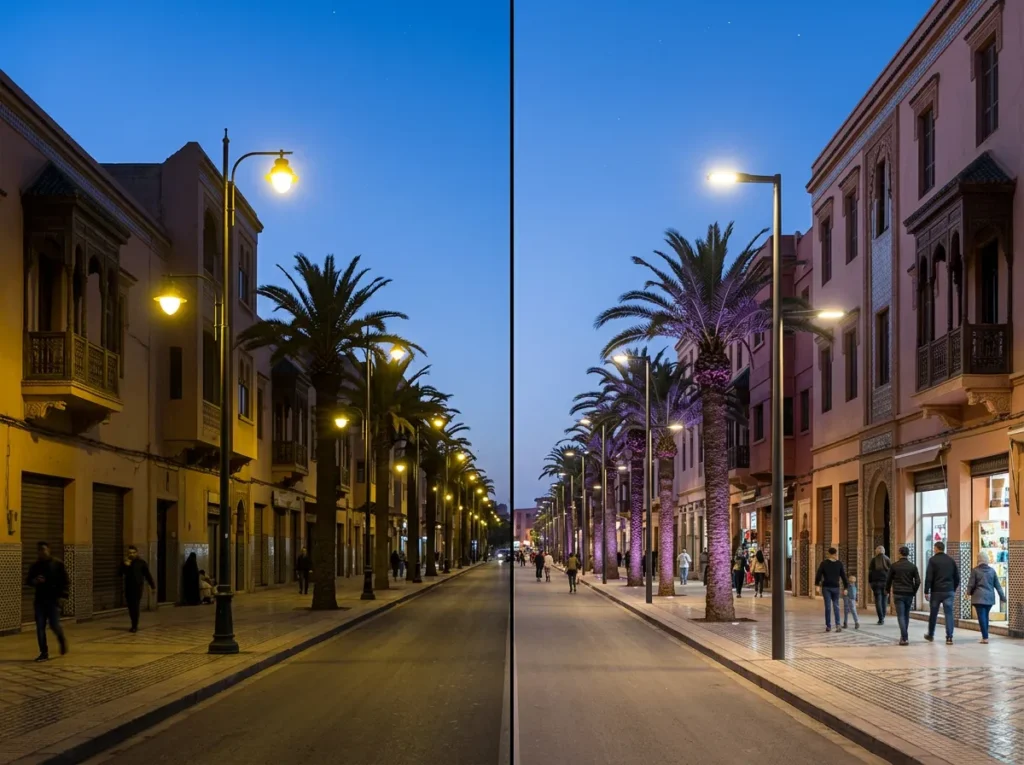
Facing rising energy costs and growing sustainability requirements, many Moroccan municipalities have begun modernizing their public lighting infrastructure. Switching to LED technology is now one of the most profitable investments for local authorities. In this article, the INGTELMA team presents the 5 concrete advantages of LED public lighting and the key elements of a successful modernization project.
Advantage 1 — Massive Reduction in Energy Bills
Public lighting accounts for an average of 30 to 40% of a Moroccan municipality's total electricity consumption. It is the largest energy expense item and the most easily optimizable.
- 50 to 70% savings on consumption: a 150W sodium vapor lamp replaced by a 60W LED consumes 60% less energy while delivering a higher lighting level.
- Fast return on investment: depending on the size of the lighting network and the applicable ONEE tariff, ROI typically falls between 4 and 7 years — not accounting for available grants and subsidies.
- Built-in dimming controls: modern LED luminaires can automatically reduce light intensity after midnight (from 100% to 50%), adding up to 20% in additional savings.
- Improved power factor: modern LED drivers achieve a cos φ above 0.95, reducing ONEE penalties related to reactive energy.
Advantage 2 — Exceptional Lifespan and Reduced Maintenance
One of the major constraints of traditional public lighting is frequent corrective maintenance — replacing lamps, ballasts, and igniters. LEDs radically transform this cost item.
- 50,000 to 100,000-hour lifespan: compared to 8,000 to 12,000 hours for a sodium lamp. At 12 hours/night of use, an LED lasts more than 11 years without source replacement.
- No warm-up phase: LEDs reach full luminous flux instantly, unlike sodium lamps which require 3 to 5 minutes. No more dark zones at startup.
- Elimination of fragile components: no electromagnetic ballast, no igniter, no capacitor to replace regularly. The integrated electronic driver is designed to last.
- Plannable maintenance: with remote management systems, faults are automatically detected and transmitted to technical teams, enabling targeted interventions rather than systematic rounds.
Advantage 3 — Superior Light Quality for Citizen Safety
Public lighting isn't just about seeing at night — it plays a fundamental role in road safety, crime prevention, and residents' well-being.
- High Color Rendering Index (CRI): LEDs achieve a CRI above 70 (compared to 25–40 for sodium), allowing colors to be clearly distinguished — a major factor for road safety and video surveillance.
- Natural white light: the 4000K to 5000K color temperature of LEDs improves visibility and reduces visual fatigue for drivers and pedestrians.
- Lighting uniformity: thanks to precision optics integrated into LED luminaires, light is distributed evenly across the roadway, with no dark spots between lampposts.
- Reduced light pollution: directional optics concentrate light downward, reducing the luminous halo toward the sky and limiting disturbance for nearby residents.
- Impact on crime: international studies show that significant improvement in public lighting reduces nighttime crime by 20 to 40% in treated areas.
Advantage 4 — Remote Management and Smart City: Real-Time Control
The true revolution of LED public lighting lies not only in the light source, but in the intelligent systems that accompany it. Remote management transforms each lamppost into a connected node of the urban network.
- Centralized supervision: from a web or mobile interface, technicians can see the real-time status of each luminaire — on, off, faulty, or in reduced mode.
- Automatic fault detection: as soon as a luminaire fails, the system generates an alarm and pinpoints the exact intervention location on a map — no more nighttime patrols to spot faults.
- Astronomical clock programming: the built-in astronomical clock automatically adjusts switch-on and switch-off times according to sunrise and sunset, without any manual intervention throughout the year.
- Dimming scenarios: programming of multiple intensity levels by time slot — 100% in the evening, 70% after 10 PM, 50% after midnight, with a gradual increase before dawn.
- Consumption data: point-by-point tracking of actual consumption, enabling precise billing and anomaly detection (power theft, insulation faults).
Advantage 5 — Environmental Impact and Compliance with Morocco's Commitments
Morocco has committed to achieving 52% renewable energy in its electricity mix by 2030 and reducing its CO₂ emissions by 45.5%. LED public lighting modernization directly supports these national objectives and local authority commitments.
- CO₂ emission reduction: each kWh saved avoids the emission of approximately 0.72 kg of CO₂ in the Moroccan electricity mix (source: ONEE). A municipality with 500 lampposts saves over 116 tonnes of CO₂ per year after switching to LED.
- No hazardous substances: unlike sodium and mercury lamps, LEDs contain no mercury or lead — substances classified as hazardous whose disposal is regulated and costly.
- Solar energy compatibility: LEDs, due to their low consumption, are perfectly suited to standalone solar systems — ideal for rural areas not connected to the ONEE grid.
- Compliance with European standards: CE-certified LED luminaires comply with EN 13201 road lighting standards — an increasingly common requirement in Moroccan municipal tenders.
- Territory enhancement: modern, coherent urban lighting improves the municipality's image, attracts investors, and enhances the nighttime architectural heritage.
Comparison: Sodium vs LED for Public Lighting
| Criterion | Sodium Lamp (legacy) | LED Luminaire (new) |
|---|---|---|
| Typical road power | 150 W | 60 W |
| Lifespan | 8,000 – 12,000 h | 50,000 – 100,000 h |
| Color Rendering Index | CRI 25 – 40 | CRI 70 – 90 |
| Startup time | 3 – 5 minutes | Instant |
| Remote management | No | Yes (GSM/LoRa) |
| Dimming capability | No | Yes (0 – 100%) |
| Hazardous substances | Sodium, mercury | None |
| Estimated annual savings | — | 50 to 70% |
How to Launch a LED Public Lighting Project for Your Municipality?
A public lighting modernization project follows several key phases that the INGTELMA team masters from start to finish.
- Existing infrastructure audit: comprehensive inventory of light points, survey of installed power ratings, condition assessment of control cabinets, poles, and underground cabling.
- Photometric study: Dialux simulation of the new layout, LED luminaire selection, calculation of lighting levels and uniformity according to EN 13201 standard.
- File preparation: technical specifications, budget estimate, 10-year profitability study, tender documents or AMEE financing application.
- Turnkey delivery: supply of LED luminaires and poles, cabling, installation of remote management cabinets, commissioning and acceptance with field measurements.
- Maintenance contract: 5-year manufacturer warranty on luminaires, annual preventive maintenance contract, on-call service for emergency interventions.
Conclusion
LED public lighting is no longer optional for Moroccan municipalities — it is an economic, environmental, and social necessity. The savings achieved often allow the project to be fully self-financed over its lifetime, while sustainably improving residents' quality of life and public space safety.
Since 2009, INGTELMA has been supporting municipalities, local authorities, and private developers in their LED public lighting projects across the Tangier-Tetouan region and throughout Morocco — from initial audit to maintenance, including turnkey delivery.