
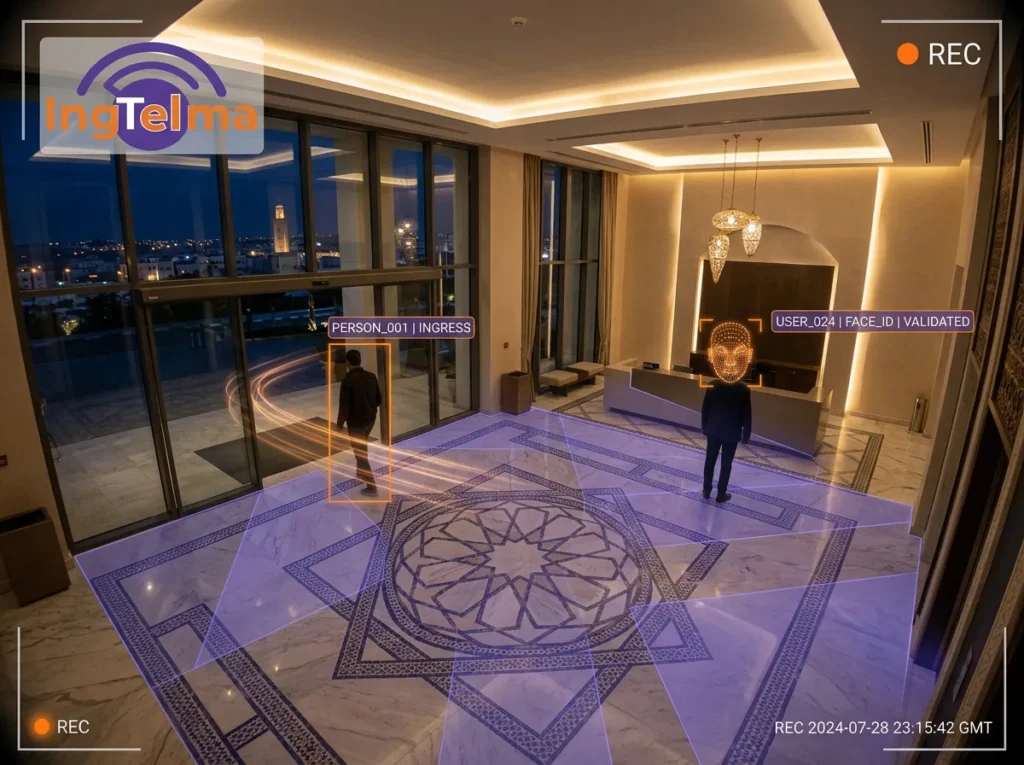
Intelligent video surveillance is no longer reserved for large corporations. Today, thanks to artificial intelligence and high-definition IP cameras, SMEs, warehouses, hotels, and commercial buildings in Morocco can benefit from industrial-grade security systems at controlled costs. This comprehensive guide helps you understand the available technologies, selection criteria, and the steps to a successful installation.
1. Traditional vs AI Video Surveillance: What's the Difference?
Traditional video surveillance records continuously and relies on a human operator to monitor the screens. AI video surveillance goes much further: it analyzes images in real time and triggers automatic alerts based on predefined rules.
- Smart motion detection: distinguishes a human from an animal or a falling leaf, eliminating 95% of false alerts.
- Suspicious behavior recognition: detects perimeter intrusion, abandoned packages, fights, or a person falling.
- People counting: measures real-time foot traffic in a space — useful for compliance and operational optimization.
- Automatic license plate reading: vehicle access control without human intervention, ideal for industrial zones and parking lots.
- Real-time alerts: push notification to smartphone as soon as an event is detected, with an attached image capture or video clip.
2. Camera Types: Choosing Based on Your Environment
Choosing the right camera is the most important decision in a video surveillance project. A camera unsuited to its environment will produce unusable images, regardless of its resolution.
Indoor Cameras
- Fixed IP dome: discreet, vandal-proof, 110° wide angle. Ideal for offices, entrance halls, corridors. Recommended resolution: 4 MP minimum.
- 180°/360° panoramic camera: a single camera covers an entire room. Reduces the number of cabling points needed.
- Counting camera: installed at height above a passageway, with built-in analytics to measure foot traffic.
Outdoor Cameras
- IP bullet with IR: night vision up to 50m, IP67 protection rating, weather-resistant. Ideal for perimeters, parking lots, entrances.
- Motorized PTZ: 30x optical zoom, 360° rotation, automatic target tracking. For large spaces — warehouses, port areas, stadiums.
- Thermal camera: detects body heat, effective in total darkness and fog. Ideal for high-security perimeter protection.
- ANPR camera (license plate reading): sensor optimized for fast capture of moving vehicles, with integrated recognition software.
3. Recording and Storage: NVR, Server, or Cloud?
Recording is the heart of the system. Without reliable storage, captured footage is lost and unusable in the event of an incident.
- NVR (Network Video Recorder): dedicated recording unit, easy to deploy. Capacity from 4 to 64 cameras depending on the model. Hard drives from 4 to 20 TB. Recording autonomy from 15 to 90 days depending on resolution and number of cameras.
- VMS server (Video Management Software): solution for large multi-camera sites (50+). Milestone XProtect or Camtrace software installed on a dedicated server. Advanced rights management, clip export, intercom and access control integration.
- Hybrid cloud storage: local recording on NVR + cloud backup of important events. Protection against NVR theft. Secure remote access from anywhere.
- SD card storage: some cameras include a micro-SD slot for autonomous recording in case of network failure — a useful backup solution.
4. Cabling and Network Infrastructure
An IP video surveillance installation relies on a solid network infrastructure. This is often the most underestimated part of the budget, yet the most critical for the final quality of the system.
- Cat6A cabling: recommended standard for IP video surveillance. Supports up to 10 Gbps over 100m, compatible with PoE+ (Power over Ethernet) to power cameras without a separate electrical cable.
- PoE switch: powers cameras via the network cable (PoE 802.3af up to 15W, PoE+ 802.3at up to 30W). Choose a managed switch to prioritize video traffic (QoS).
- Fiber optic backbone: for distances exceeding 100m or between buildings. Media converters or SFP switches for integration.
- Cable trays: metal cable trays or PVC trunking, separated from high-current electrical cables to avoid interference.
- UPS (Uninterruptible Power Supply): essential for NVRs and switches. Ensures recording continuity during power outages.
5. Regulations in Morocco: What You Need to Know
Video surveillance in Morocco is governed by several legislative texts. A non-compliant installation exposes the company to penalties and invalidates video evidence in case of litigation.
- Law 09-08 on personal data protection: any video surveillance installation processing images of individuals must be declared to the CNDP (National Commission for the Control of Personal Data Protection).
- Mandatory signage: information signs must indicate the presence of cameras in monitored areas accessible to the public.
- Limited retention period: recordings cannot be kept beyond 30 days unless legal proceedings are ongoing.
- Restricted image access: only authorized personnel (security, management, law enforcement upon request) may view the recordings.
- Prohibited areas: cameras cannot film rest areas, changing rooms, or sanitary facilities.
6. Steps of a Professional Installation
A properly executed video surveillance installation follows a structured 5-step process. Skipping a step risks ending up with an ineffective or non-compliant system.
- Site security audit: on-site visit, identification of high-risk areas, blind spot analysis, definition of surveillance objectives (deterrence, identification, evidence).
- System design: camera placement plan, field of view calculated for each point, equipment selection, storage sizing, detailed quote.
- Infrastructure and cabling: running Cat6A cables, installing cable trays, mounting trunking, installing PoE switches and the NVR/server.
- Installation and configuration: mounting cameras, aligning fields of view, configuring AI analytics, setting up alerts and access rights.
- Training and handover: training users on the VMS interface, handing over the cabling plan, access codes, and maintenance contract.
Comparison: System Types by Site Size
| Site Type | No. of Cameras | Recommended Solution | Storage |
|---|---|---|---|
| Office / Retail | 4 – 8 | 8-channel NVR + 4 MP cameras | 4 TB / 30 days |
| Warehouse / SME | 8 – 24 | 16/32-channel NVR + outdoor PTZ | 8–16 TB / 30 days |
| Hotel / Residence | 24 – 64 | VMS server + 8 MP cameras | 20–40 TB / 30 days |
| Industrial Site | 64 – 200+ | VMS Milestone XProtect + thermal | NAS rack 100+ TB |
| Multi-site | Variable | Centralized VMS + hybrid cloud | Cloud + local per site |
7. Maintenance: Protecting Your Investment Over Time
A video surveillance system without maintenance degrades rapidly. Cameras get dirty, hard drives fill up, firmware becomes vulnerable. A preventive maintenance contract is essential.
- Biannual visit: lens cleaning, bracket inspection, field of view testing, available disk space check.
- Firmware updates: manufacturers regularly release security patches. Outdated firmware is an open door for hackers.
- AI alert testing: verifying that detection zones are still correctly configured and that alerts reach the intended recipients.
- Hard drive replacement: surveillance hard drives have a lifespan of 3 to 5 years under continuous 24/7 operation. Preventive replacement is recommended.
- Rapid response on-call service: INGTELMA offers on-call contracts with response within 4 hours for critical sites.
Conclusion
AI video surveillance is now accessible to all Moroccan businesses, regardless of size. When properly designed and correctly installed, it deters intrusions, protects your assets, secures your teams, and provides usable evidence in case of an incident.
As a certified Axis and Milestone partner, INGTELMA supports its clients from security audit to maintenance, including design and installation. Our teams operate across Tangier, Tetouan, and the entire northern region of Morocco.