
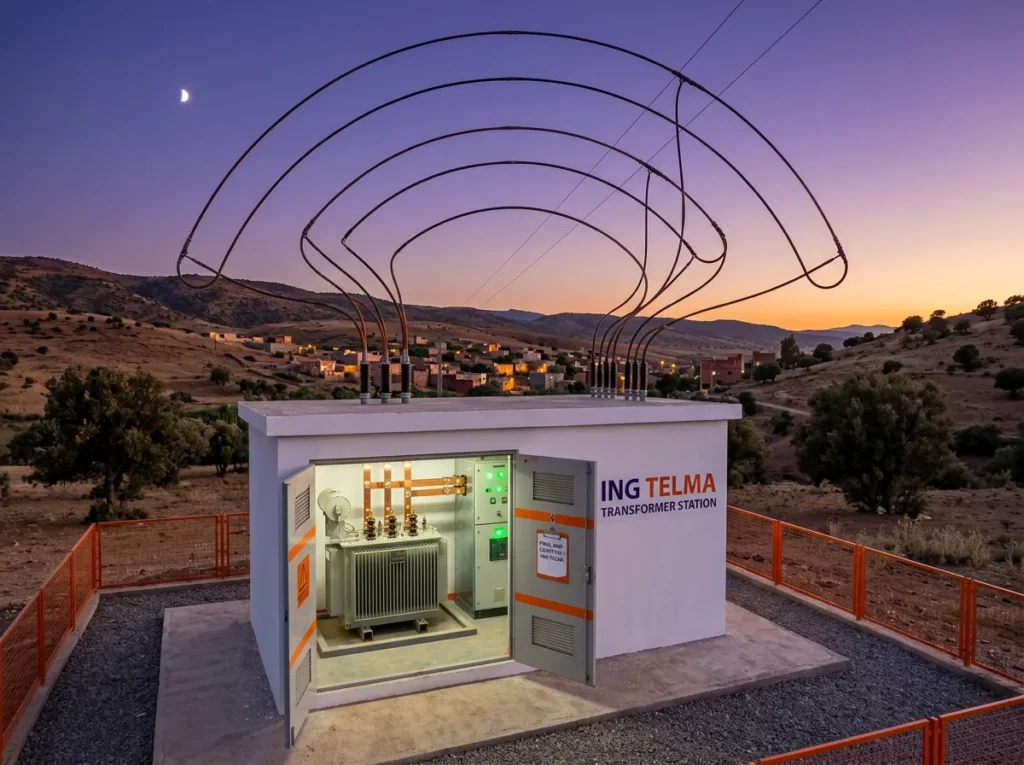
An HTA/LV (Medium Voltage/Low Voltage) transformation substation is the heart of any industrial or commercial electrical infrastructure in Morocco. It converts the ONEE high voltage supply (15,000 V or 20,000 V) into usable low voltage (400 V / 230 V). If poorly sized or improperly installed, it poses a major risk to business continuity and personal safety. In this article, the INGTELMA team walks you through the key steps of a successful installation.
1. Preliminary Study: Sizing Before Installing
Before purchasing any equipment, a thorough technical study is essential. This phase determines the required transformer capacity (expressed in kVA), the type of substation suited to the site, and the regulatory constraints to be met.
- Power assessment: inventory of all electrical loads on-site (machinery, lighting, air conditioning, UPS systems, etc.) with their simultaneity and diversity factors.
- Transformer capacity selection: typically 160, 250, 400, 630, or 1000 kVA based on calculated demand, with a 20–30% reserve for future expansion.
- Substation type: masonry cabin substation, prefabricated concrete substation, or pole-mounted substation depending on available space and ONEE requirements.
- Short-circuit study: calculation of short-circuit current to size the protection devices (MV circuit breakers, LV fuses).
2. Administrative Procedures and ONEE Approval
In Morocco, any connection to the ONEE MV network is subject to a strict regulatory process. Only companies certified by ANRE (National Electricity Regulation Authority) are authorized to carry out this work.
- Mandatory MV-LV certification: the contractor must hold an MV-LV certification issued by ANRE. INGTELMA holds a Class 3 certification with no power limit.
- ONEE technical file: single-line diagram, site layout plan, calculation report, transformer data sheet — to be submitted for approval before work begins.
- Connection agreement: signing of an agreement with ONEE defining the connection conditions and responsibilities of each party.
- Road permit: required if the work involves trenching in public land for the MV supply cable.
3. Civil Works: The Foundation of Safety
The civil engineering aspect of a transformation substation is often underestimated. Yet poor execution can compromise the entire installation.
- Excavation and foundation: digging and pouring a reinforced concrete raft slab designed to support the transformer weight (from 800 kg to over 3 tonnes depending on capacity).
- Building construction: cinder block or reinforced concrete walls, anti-intrusion metal door, mandatory high and low ventilation for heat dissipation.
- Grounding network: installation of separate MV and LV earth electrodes, in accordance with NFC 13-100 standard. Ground resistance must be below 1 ohm for MV substations.
- Switching platforms: insulating floor covering in front of MV and LV panels to protect operators during switching operations.
- Oil containment pit: mandatory for oil-immersed transformers, to contain any dielectric fluid leaks.
4. Substation Equipment: Materials and Installation
The equipment of an HTA/LV substation includes several critical components that must be carefully selected and installed according to best practices.
MV Side (Medium Voltage)
- MV switchgear (RMU or modular cells): cable intake, transformer protection (fuses or circuit breaker), ONEE metering. Reference brands: Schneider Electric, ABB, Siemens.
- MV supply cable: 15 kV or 20 kV cable with XLPE insulation, laid in trench or duct — length depends on the distance to the ONEE network.
- HTA/LV transformer: oil-immersed or dry-type (resin) transformer, rated capacity as determined in the study. Minimum ingress protection IP 23.
LV Side (Low Voltage)
- MSB (Main Switchboard): main circuit breaker, copper busbars, outgoing feeders to distribution boards. Rating based on the transformer's nominal current.
- ONEE metering: metering cabinet with active and reactive energy meters, supplied and sealed by ONEE after inspection.
- Reactive power compensator: capacitor bank to correct the power factor (cosφ) and avoid penalties on the ONEE electricity bill.
5. Commissioning and Testing
Commissioning a transformation substation is a critical step that cannot be improvised. It must be carried out in the presence of an ONEE representative and a qualified engineer.
- Connection verification: checking the tightness of all terminals, measuring insulation resistance of MV and LV cables (5000 V megohmmeter).
- Earth electrode testing: measuring ground resistance with an earth tester — must comply with values calculated in the study.
- Protection checks: verifying protection relay settings, testing MV cell trip functions.
- Progressive energization: MV energization by the ONEE agent, verification of LV voltage levels under load, no-load current measurement.
- Acceptance report: document signed by ONEE, the client, and the contractor — mandatory for final connection.
6. Preventive Maintenance: Protecting Your Investment
A well-maintained transformation substation can operate without incident for 30 to 40 years. Without maintenance, failures typically occur within 8 to 12 years.
- Annual inspection: cleaning switchgear cells, checking connections (infrared thermography), verifying transformer oil level, testing protection relays.
- Oil analysis (every 3 years): dielectric and chromatographic analysis of transformer oil to detect internal degradation before failure occurs.
- General overhaul (every 5 years): seal replacement, general retorquing of connections, verification and recalibration of protection devices.
- On-call service contract: emergency response within 4 hours in case of failure, available 24/7.
Summary: Transformer Capacities and Their Applications
| Capacity (kVA) | Typical Application | LV Current (A) | Room Size (m²) |
|---|---|---|---|
| 160 kVA | Small industry, residential building | ~231 A | ~15 m² |
| 250 kVA | SME, medium-sized shopping center | ~361 A | ~20 m² |
| 400 kVA | Light industry, 4–5 star hotel | ~577 A | ~25 m² |
| 630 kVA | Heavy industry, free trade zone | ~909 A | ~30 m² |
| 1000 kVA | Large industry, data center | ~1443 A | ~40 m² |
Conclusion
Installing an HTA/LV transformation substation is a demanding technical project that requires specialized expertise, regulatory certifications, and uncompromising execution rigor. Every step — from the study to the acceptance report — determines the reliability and lifespan of your electrical infrastructure.
Since 2009, INGTELMA has been delivering turnkey transformation substations for industrial, public, and commercial clients across Morocco. Our Class 3 MV-LV certification with no power limit and our H2V-qualified teams guarantee installations that comply with ONEE and NFC 13-100 standards.